
What Sports Recovery Science Gets Right That Commerce Intelligence Often Gets Wrong
June 22, 2026
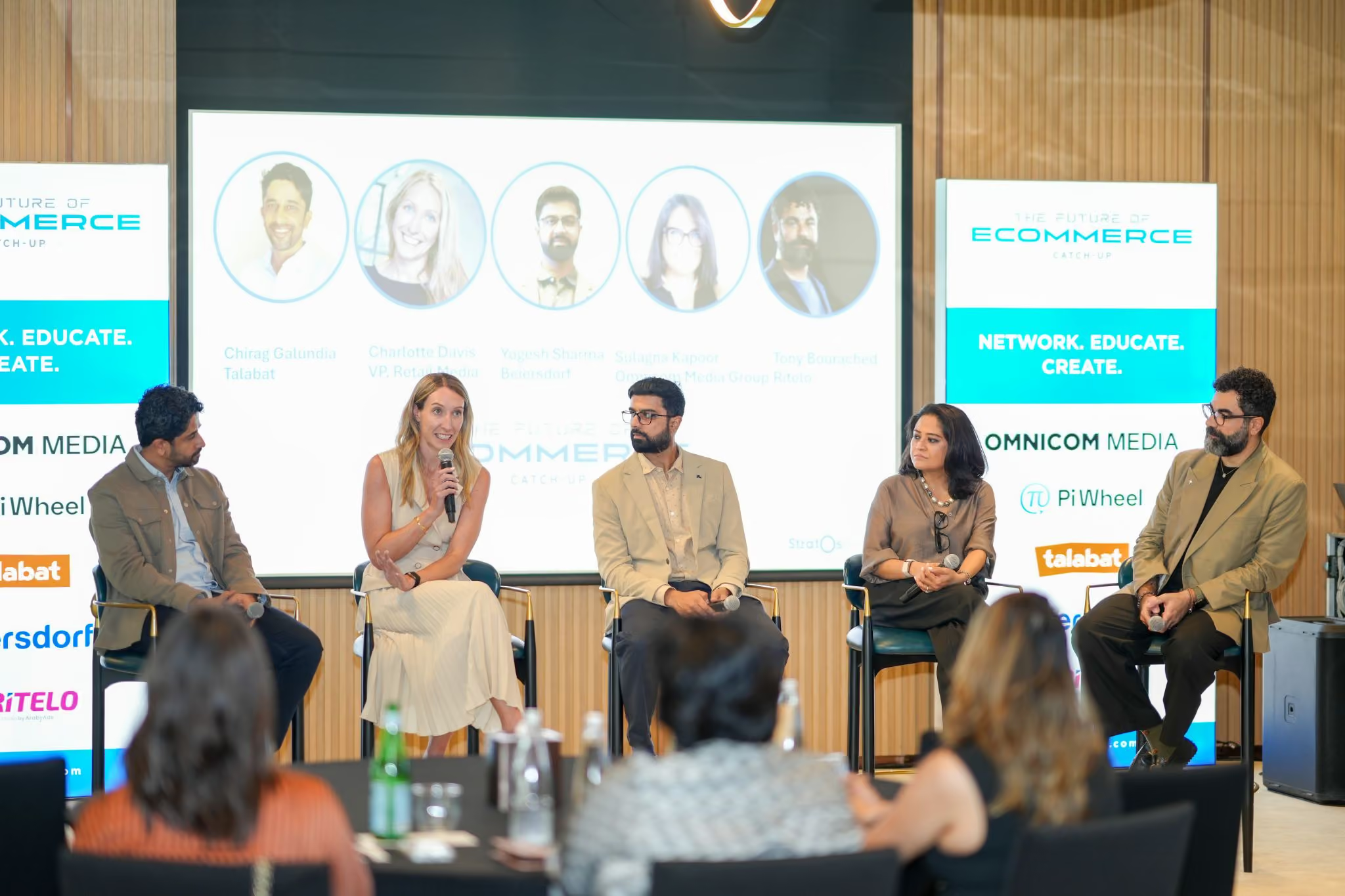
Last month I attended the Stratos Pulse Recovery Briefing — a gathering of performance specialists, sports scientists, and brand leaders convened around the science of athletic recovery. It was not a typical industry event for someone who runs a commerce intelligence company. But I came away with some of the clearest thinking I have had in months about what it means to build systems that actually improve performance over time.
The parallel between elite sports recovery and commerce performance is not metaphorical. It is structural. And I think it explains why so many brands invest heavily in the visible, exciting parts of commerce — the campaigns, the launches, the platform activations — while systematically underinvesting in the infrastructure that determines whether any of that actually compounds into growth.
The Recovery Principle
The core insight from sports science that the briefing kept returning to is this: performance does not improve during training. It improves during recovery. The stress of training creates the stimulus. The recovery is where adaptation happens.
Elite athletes and their coaches understand that recovery is not downtime. It is the most productive phase of the performance cycle. It is where the gains are locked in, where data is processed, where the body adapts. Get the recovery wrong and the training produces no improvement — or actively causes harm.
The analogy for commerce is almost exact.
The Commerce Performance Cycle
Most brands treat their commerce activity as a series of activation moments — a campaign goes live, a product launches, a promotional period runs. The focus goes into the activation. The budget, the creative, the media, the content. Then the activation ends and the organisation moves to the next one.
What very few brands do systematically is the commerce equivalent of recovery: the deep analysis of what just happened, why it happened, and what the data is telling you about where to go next. Not a campaign debrief. Not a slide deck of impressions and reach. A genuine interrogation of what the activation revealed about your competitive position, your content quality, your search rankings, your conversion rates, your price-to-value perception.
That analysis is where the real gains are. It is where you find out that your main product image is underperforming against category norms. That your sponsored search strategy is bidding on terms that attract browsers rather than buyers. That a competitor has improved their listing quality and is now outranking you on the searches that matter most. That your in-store and online execution are telling two different stories to the same customer.
Why Brands Skip the Recovery Phase
The honest answer is that activation is visible and recovery is not. A campaign launch has a kickoff, a go-live, a results report. It has stakeholders and timelines and creative reviews. It generates energy and output.
The intelligence phase — the systematic review, the data interrogation, the strategic adjustment — happens quietly, requires patience, and does not produce the kind of tangible deliverables that make it easy to justify budget or attention. In most organisations it gets deprioritised in favour of the next activation.
The result is a commerce performance cycle that generates a lot of activity but does not compound. Each campaign starts roughly where the last one ended. The organisation gets busier but does not get smarter.
What the Science Suggests
The sports science literature on recovery points to a few consistent findings that translate well to commerce.
First, measurement has to be continuous, not episodic. Athletes do not measure recovery only at the end of a training block. They monitor it throughout — sleep quality, heart rate variability, muscle readiness — so they can adjust in real time. Commerce brands that measure performance only at campaign end are operating with a significant lag. By the time the data is reviewed, the decisions that could have improved the outcome have already been made.
Second, the recovery protocol has to be tailored to the individual, not applied generically. What works for one athlete does not automatically work for another. The same is true for brands — what works in one category, one platform, or one market does not transfer without adjustment. Intelligence has to be contextual.
Third, the most important metric is not how hard you trained. It is whether you are ready to perform again. For a commerce brand, that means asking not just how a campaign performed, but whether the organisation is now better positioned — better ranked, better stocked, better understood by its target customer — than it was before.
Building the Intelligence Infrastructure
What strikes me about the most commercially successful brands operating in MENA right now is that they have figured out how to make the recovery phase a competitive advantage. They treat post-activation analysis as a structured discipline, not an optional debrief. They have frameworks for what good looks like across every touchpoint — digital shelf, sponsored search performance, content quality, conversion benchmarks. And they use those frameworks to make faster, better-calibrated decisions about where to invest next.
That is not a technology advantage. It is an intelligence advantage. And it is available to any brand that decides to build it.
The Compounding Effect
The reason elite athletes invest so heavily in recovery is that the gains compound. Two athletes following the same training programme will diverge significantly over time if one is recovering intelligently and one is not. The better-recovered athlete absorbs more of each training stimulus, adapts faster, and enters each new training block from a higher baseline.
Commerce works the same way. A brand that systematically learns from each activation cycle — that adjusts its digital shelf, its search strategy, its content, its pricing signals — enters each new campaign from a stronger position. Over twelve months, the compounding effect is substantial. Over three years, it is often the difference between category leadership and category irrelevance.
The Stratos Pulse Briefing was a reminder that the science of performance has a lot to teach the science of commerce. The principles are the same. The discipline required to apply them is the same. And the rewards for getting it right are just as significant.